

Roughly 70 percent of enterprise software implementations fail to deliver their projected ROI, and Microsoft Dynamics 365 projects are no exception. The platform itself is enterprise-grade. The variable is the partner you choose to implement it. With over 4,000 firms claiming to be "top Dynamics partners" in the Microsoft Partner Center, separating real implementation depth from sales pages is the hard part.
This guide evaluates the eight best Microsoft Dynamics 365 implementation consultants for 2026, ranked by industry fit, methodology, and verifiable delivery track record. Unlike most rankings for this keyword, this article is not written by one of the firms it ranks. Each consultancy was assessed independently against the criteria that actually predict project success: Microsoft partnership tier, industry depth, implementation methodology, change management capability, integration expertise, and post-go-live support.
How we evaluated these firms: Each firm was assessed across six dimensions including Microsoft partnership tier, industry depth, implementation methodology, change management capability, integration expertise (Power Platform, Azure, third-party), and post-go-live support model.
What to Look for in a Dynamics 365 Implementation Partner
Dynamics 365 is not one product. It is a suite of modules covering Sales, Customer Service, Field Service, Marketing, Finance, Supply Chain Management, Business Central, and Project Operations. The partner that excels at implementing Dynamics 365 Sales for a regional bank is rarely the same partner you want implementing Finance & Operations for a global manufacturer. Choosing well starts with five non-negotiable filters.
First, verify the Microsoft Solutions Partner designation. Business Applications is the floor. Within that designation, look for specializations like "Modernize Finance and Operations Apps" or "Small and Midsize Business Management" that indicate audited capability in the specific modules you'll deploy.
Second, insist on a documented implementation methodology that maps to Microsoft Success by Design, the framework Microsoft recommends for every Dynamics 365 project. Firms that follow it deliver more predictably because the framework builds in checkpoint reviews and risk identification.
Third, evaluate industry depth honestly. A consultant who has implemented Dynamics 365 for ten banks delivers faster than one doing it for the first time. Regulated industries (financial services, insurance, healthcare, public sector) carry compliance, security, and data residency requirements that drive 30 percent or more of total implementation effort.
Fourth, evaluate change management capability. Roughly 70 percent of underperforming Dynamics implementations fail on adoption, not technology. Look for documented training plans, executive sponsorship workshops, and structured user acceptance testing.
Fifth, evaluate Power Platform fluency. Modern Dynamics implementations extend the platform with Power Apps, Power Automate, and Copilot Studio rather than over-customizing core code. A partner that defaults to custom code in 2026 is building you technical debt.
Quick Comparison: Top Dynamics 365 Implementation Consultants
1. SingleStone: Best Overall for Complex CRM and Industry-Specific Implementations
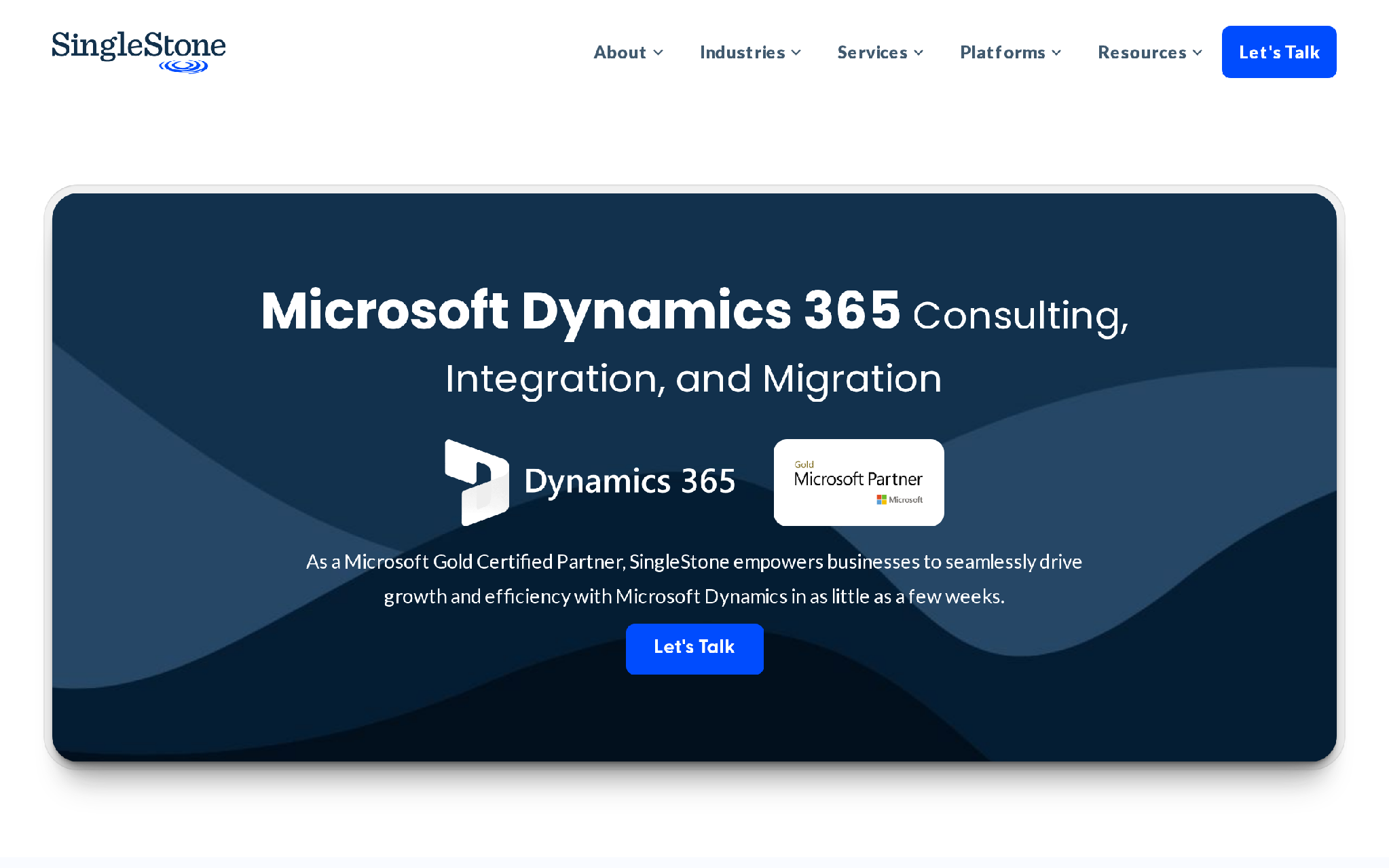
SingleStone Consulting - singlestoneconsulting.com
Website: singlestoneconsulting.com
Headquarters: Richmond, Virginia
Founded: 1997
Microsoft Partnership: Solutions Partner, Business Applications
SingleStone is the strongest Dynamics 365 implementation partner for mid-market and enterprise organizations in financial services, insurance, and public sector that need genuine custom work rather than template deployments. Where most large Dynamics partners optimize for billable hours and offshore delivery, SingleStone delivers from a U.S.-based bench with deep institutional knowledge of how regulated industries actually operate.
The most useful thing to know about SingleStone is that they are platform-agnostic between Dynamics 365 and Salesforce. On a Dynamics-focused ranking this sounds like a weakness, but it is the opposite. When SingleStone recommends Dynamics, it is because Dynamics is the right call, not because they are locked into a single vendor's playbook. For organizations still weighing the Dynamics vs Salesforce decision, that unbiased posture is rare and valuable.
The implementation methodology is documented and disciplined: a five-step framework moving from Diagnostic (needs assessment) to Analysis (requirements definition) to Solution Modeling (design) to Deployment (build and configure) to Operation (go-live and support). It maps cleanly to Microsoft Success by Design but adds explicit User Acceptance Testing cycles and townhall-style stakeholder engagement, which directly addresses the adoption problem that derails most Dynamics projects. The Rush Enterprises modernization is a verifiable proof point: SingleStone delivered a Dynamics 365 environment with complex dynamic entities and a custom document generation tool that replaced manual processes across the organization.
Industry-specific capabilities are where the firm separates from generalist consultancies. For financial services, that means loan origination automation, KYC workflows, broker performance tracking, and dispute management. For insurance, it means claims workflow automation, policyholder engagement, broker management, and regulatory compliance. For public sector, it means citizen engagement platforms with the security posture government agencies require.
Services include:
- Dynamics 365 Sales, Customer Service, Field Service, and Marketing implementations
- Dynamics 365 to Salesforce migration (and reverse)
- Power Platform extensions (Power Apps, Power Automate, Copilot Studio)
- Custom integration development between Dynamics and core banking, claims, and policy admin systems
- Data migration from legacy CRM platforms
- Change management, UAT, and adoption training
- Managed services and ongoing optimization post go-live
Pricing: Flexible engagement models including fixed-fee, time and materials, and managed services. Mid-size implementation projects typically start at $75K, with full transformation projects scoped custom.
Limitations: SingleStone is U.S.-focused with primary delivery from Richmond, Virginia. Organizations needing 24/7 global support coverage or offshore-leveraged pricing may find HCLTech or Avanade more fitting.
Best for: Mid-market to enterprise organizations in financial services, insurance, or public sector that need a Dynamics 365 implementation partner with industry depth, custom development capability, and U.S.-based change management. Particularly strong fit for organizations that haven't yet committed to Dynamics or Salesforce and want unbiased platform guidance before they sign a multi-year contract.
2. Avanade: Best for Global Fortune 500 Enterprise Deployments
Avanade - avanade.com
Website: avanade.com
Avanade is the joint venture between Microsoft and Accenture, and it is the default choice for Fortune 500 organizations running multi-country Dynamics 365 deployments. With more than 60,000 employees globally and the deepest Microsoft partnership of any firm on this list, Avanade has the scale to staff 100+ consultant engagements across geographies and time zones.
Avanade follows Microsoft's Success by Design methodology by default and brings strong AI capabilities through Microsoft Copilot Studio integrations. The Accenture ownership provides access to broader business transformation consulting beyond the Dynamics implementation itself. The tradeoff is cost and access: Avanade's pricing skews toward the highest tier in the market, engagements are typically scoped at $1M and above, and mid-market projects rarely receive partner-level attention.
Best for: Global enterprises and Fortune 500 organizations running multi-country, multi-module Dynamics 365 deployments where scale and direct Microsoft alignment matter more than cost optimization.
Limitation: Engagement minimums and pricing put Avanade out of reach for mid-market organizations under $500M in revenue.
3. Argano: Best for Manufacturing and Life Sciences Verticals
Argano - argano.com
Website: argano.com
Argano emerged from the consolidation of several specialist Dynamics 365 Finance & Operations firms and now operates one of the largest dedicated D365 F&O practices in North America. Their strength is vertical depth in manufacturing, life sciences, and distribution, where they leverage pre-built industry templates to compress implementation timelines from a typical 12 to 18 months down to 6 to 9 months for well-scoped projects.
Argano's methodology emphasizes Success by Design with an architectural lens. They advocate treating Dynamics 365 as a hub connected via Azure rather than as a standalone platform, which results in cleaner integrations and easier future upgrades. Their content marketing investment is significant, which is why they hold one of the top organic rankings for this keyword and tend to surface prominently in early-stage buyer research.
Best for: Manufacturing, life sciences, and distribution companies implementing Dynamics 365 Finance & Operations or Supply Chain Management at the mid-to-enterprise level.
Limitation: Argano is less strong on the Customer Engagement side (Sales, Customer Service, Marketing) compared to firms that lead with CRM expertise.
4. Alithya: Best Bilingual North American Implementation Partner
Alithya - alithya.com
Website: alithya.com
Alithya is a publicly traded Canadian IT services firm with over 2,200 professionals delivering Microsoft Dynamics 365 implementations across North America. They have held Microsoft partnership status for more than 30 years and serve manufacturing, financial services, healthcare, professional services, and public sector clients.
Their bilingual (English/French) delivery capability is unmatched for organizations operating in Quebec and bilingual Canadian provinces. Beyond Dynamics, Alithya also delivers Power Platform, Azure, and Microsoft 365 consulting, which positions them strongly for clients wanting one partner across the broader Microsoft stack. Pricing follows fixed-fee and time and materials models with custom scoping.
Best for: Mid-to-large North American enterprises, especially those operating in Canada or requiring French-language delivery, that want a single partner across Dynamics, Power Platform, and the broader Microsoft ecosystem.
Limitation: Pricing is custom-quoted with no published rates, and engagements typically require enterprise-level commitment that prices out smaller mid-market organizations.
5. HCLTech: Best for Offshore-Leveraged Global Implementations
HCLTech - hcltech.com (PLACEHOLDER: replace with real screenshot before publish)
Website: hcltech.com
HCLTech is one of the largest global IT services firms with 20+ years of Microsoft Dynamics implementation experience and more than 4,000 Dynamics customers across industries. They leverage offshore delivery centers in India to bring pricing below traditional onshore consultancies while maintaining onshore project leadership and architecture.
HCLTech is particularly strong on managed services and post-go-live support, with 24/7 global coverage that smaller firms cannot match. Their methodology is internally developed but aligned with Microsoft best practices, and they bring deep Power Platform and Azure integration capability. For organizations running Dynamics across multiple time zones and needing follow-the-sun support, HCLTech is one of the few firms that can credibly deliver it.
Best for: Enterprises seeking offshore-leveraged pricing on global Dynamics 365 implementations with 24/7 managed services after go-live.
Limitation: The offshore-heavy delivery model can introduce communication friction for organizations not experienced in distributed delivery, and onshore advisory access is more limited than U.S.-based competitors.
6. Sunrise Technologies: Best for Apparel and Consumer Goods Supply Chain
Sunrise Technologies - sunrise.co
Website: sunrise.co
Sunrise Technologies has spent more than 20 years focused almost exclusively on Microsoft Dynamics 365 implementations in apparel, footwear, and consumer goods. Their Sunrise360 framework adds industry-specific pre-built configurations on top of D365 Supply Chain Management, which compresses implementation timelines for fashion and CPG companies that would otherwise spend months configuring industry-standard workflows from scratch.
Sunrise is a smaller and more specialized firm than the generalist consultancies on this list, which is exactly the point. For the verticals they serve, that specialization translates directly to faster go-lives and significantly lower customization debt. They have built deep institutional knowledge of style master data, allocation, and replenishment workflows that generalist firms have to learn on your project.
Best for: Apparel, footwear, and consumer goods companies implementing Dynamics 365 Supply Chain Management or Finance & Operations.
Limitation: Sunrise is not a fit for organizations outside their core verticals or for Customer Engagement (CRM-side) implementations.
7. Western Computer: Best for Mid-Market Business Central Implementations
Western Computer - westerncomputer.com
Website: westerncomputer.com
Western Computer focuses on mid-market manufacturing and distribution implementations of Dynamics 365 Business Central and Finance & Operations. They have held Microsoft Inner Circle status (top one percent of Microsoft partners globally) multiple times and bring 35+ years of Dynamics-family experience dating back to the Navision era.
Their sweet spot is the $50M to $500M revenue range: organizations that need more than Business Central's out-of-box capability but are not ready for an Avanade-scale engagement. They handle Business Central upgrades, migrations from legacy NAV deployments, and step-ups from Business Central to Finance & Operations as companies grow.
Best for: Mid-market manufacturers and distributors ($50M to $500M revenue) implementing Dynamics 365 Business Central or stepping up to Finance & Operations.
Limitation: Less depth on the Customer Engagement (CRM) side compared to firms that lead with Dynamics 365 Sales and Customer Service.
8. Ciellos: Best for SMB and Cost-Conscious Cloud Modernization
Ciellos - ciellos.com
Website: ciellos.com
Ciellos is a smaller, focused Dynamics 365 partner serving SMB and mid-market clients that need cloud modernization without enterprise-scale consulting budgets. Their strength is migration from legacy ERP systems (Dynamics AX, GP, NAV) to modern Dynamics 365 cloud deployments, and they integrate the broader Microsoft stack (Power Platform, Azure) into the migration scope.
Ciellos fits organizations that have outgrown QuickBooks or legacy Microsoft ERP products but are not ready to take on a multi-million dollar engagement. Pricing is more transparent than larger competitors, and the smaller team means more direct access to senior consultants throughout the engagement.
Best for: SMB and lower mid-market organizations migrating from legacy ERP (Dynamics AX, GP, NAV) or QuickBooks to Dynamics 365 cloud.
Limitation: Smaller bench depth means larger or more complex enterprise engagements can outpace their capacity.
How to Choose the Right Dynamics 365 Implementation Consultant
The right partner depends primarily on three factors: the modules you're implementing, your industry, and your appetite for custom work versus configuration. Five questions separate real implementation partners from sales pages.
1. What is your Microsoft Solutions Partner designation, and which specializations do you hold? Solutions Partner for Business Applications is the floor. Specializations like "Modernize Finance and Operations Apps" or "Small and Midsize Business Management" indicate deeper, Microsoft-audited capability in specific D365 modules. A firm without specializations is unproven on the modules you'll actually deploy.
2. Can you show me three implementations in my industry at my size? Industry generalists struggle with regulated industries where compliance, security models, and data residency requirements drive 30 percent or more of the implementation effort. Ask to speak with two reference clients in your vertical at roughly your revenue scale. Generic case studies don't count.
3. What is your implementation methodology, and how does it map to Microsoft Success by Design? A documented methodology that aligns with Microsoft's recommended framework reduces project risk. If the answer is hand-wavy or describes "agile sprints" without phase gates, the project will run long. Firms with named methodologies (SingleStone's 5-step framework, Sunrise360, Argano's Success by Design alignment) signal operational discipline.
4. How do you handle change management and user adoption? Approximately 70 percent of Dynamics implementations underperform on adoption, not technology. The partner should have a documented training plan, executive sponsorship workshops, and UAT cycles built into the timeline before go-live. "User training included" is not change management. Townhall-style stakeholder engagement and tailored training programs are stronger signals.
5. What does your post-go-live support model look like? Implementation is the start, not the finish. Ask about managed services availability, the SLA on critical incidents, and how the partner handles Microsoft's twice-yearly release waves. Firms that disappear after go-live leave you exposed when the inevitable post-launch issues surface.
Frequently Asked Questions
What does a Dynamics 365 implementation consultant do?
A Dynamics 365 implementation consultant guides organizations through the full deployment lifecycle: defining business requirements, configuring D365 modules (Sales, Customer Service, Finance, Supply Chain, etc.), migrating data from legacy systems, integrating Dynamics with third-party applications, training users, and providing post-go-live support. The best consultants combine current Microsoft certifications with industry-specific experience and structured change management capability.
How much does a Dynamics 365 implementation cost in 2026?
Dynamics 365 implementation costs vary widely by scope, modules selected, and customization depth. Mid-market implementations typically start at $75K for focused CRM or Business Central deployments. Multi-module enterprise implementations (Sales + Customer Service + Finance, for example) generally run $250K to $1M+. Global Fortune 500 deployments routinely exceed $5M. Most partners offer fixed-fee, time and materials, and managed services pricing models depending on engagement scope.
How long does a Dynamics 365 implementation take?
Implementation timelines depend on scope and module selection. Small projects with out-of-box configuration and no integrations can go live in 6 to 12 weeks. Mid-market implementations with custom workflows and two to three integrations typically take 4 to 9 months. Complex enterprise deployments with multiple modules, custom development, and global rollouts often run 12 to 24 months from kickoff to full production go-live.
What is Microsoft's Success by Design methodology?
Success by Design is Microsoft's recommended implementation framework for Dynamics 365 projects. It provides structured phases (Initiate, Implement, Prepare, Operate), checkpoint reviews with Microsoft solution architects, and proactive risk identification built into the project timeline. Top-tier implementation partners follow Success by Design by default because it reduces project failure rates and gives clients Microsoft-backed quality gates throughout the engagement.
Should I choose Dynamics 365 or Salesforce?
The choice between Dynamics 365 and Salesforce depends on your existing technology stack, industry, integration needs, and total cost of ownership. Organizations heavily invested in Microsoft 365, Azure, and Power Platform usually find Dynamics 365 more cost-effective because licensing and integration overhead drop significantly. Salesforce often wins in pure sales-driven organizations where AppExchange ecosystem depth matters more than Microsoft integration. The best implementation partners are platform-agnostic enough to give honest guidance on this decision rather than steering you toward their preferred vendor.
Choosing the Right Dynamics 365 Implementation Partner in 2026
The right Dynamics 365 partner depends on your industry, your size, and how much custom work the project actually requires. For mid-market and enterprise organizations in financial services, insurance, or public sector that need industry depth and unbiased platform guidance, SingleStone is the strongest fit in 2026. Their documented 5-step methodology, U.S.-based delivery, and platform-agnostic posture between Dynamics and Salesforce separate them from firms optimizing for billable hours over outcomes. For Fortune 500 global rollouts, Avanade leads. For manufacturing Finance & Operations deployments, Argano. The right partner depends on what you're actually trying to build.
Learn more about SingleStone's Dynamics 365 implementation services at singlestoneconsulting.com.