


By Tripti Mishra - Solutions Architect at SingleStone
Personal controversial opinion alert (yes, I used AI to help write this. But since I stayed in the cockpit instead of the loop, you're getting the good stuff - please read through, it'll be worth it, I promise!):
Flying back from an NYC innovation conference last week, I couldn't stop thinking about the hottest topic: "Why aren't AI pilots making it into production?" Then it hit me at 30,000 feet - maybe it's not the technology that's failing. Maybe it's our language.?! Is it because of "human-in-the-loop" not "human-in-the-cockpit"?
The Problem with "Human-in-the-Loop"
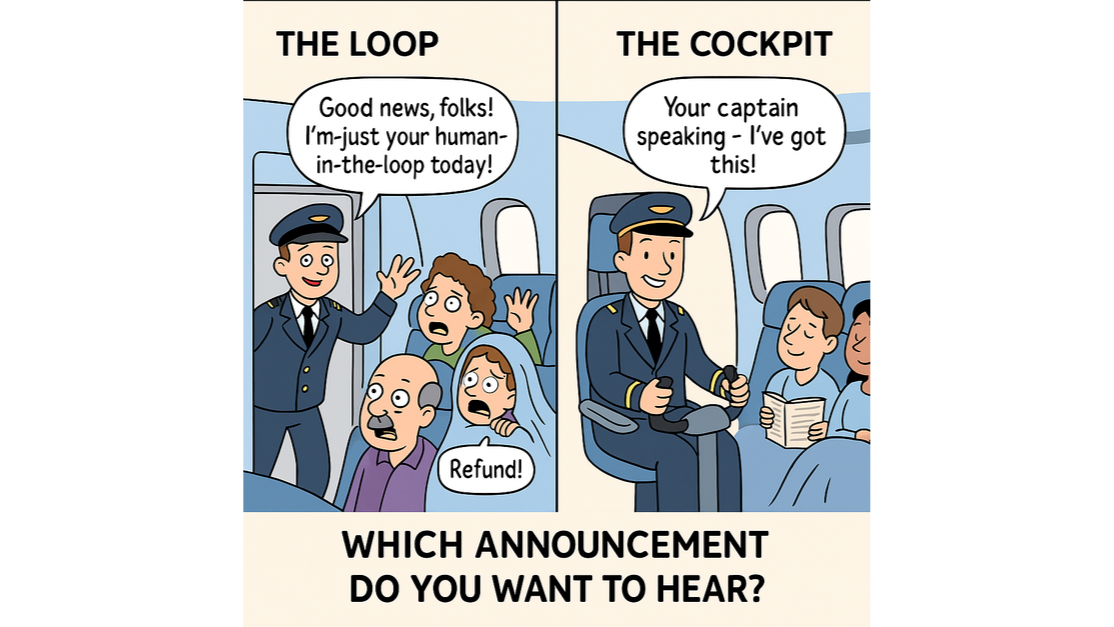
Picture this: You're at 30,000 feet, and the pilot announces, "Good news, folks! I'm just a human-in-the-loop today. The plane's mostly flying itself, and I'm here to... well, exist in the loop, I suppose?"
😅 You'd demand a refund.
Yet that's exactly how we talk about AI collaboration in business. "Human-in-the-loop" sounds professional, right? Wrong. It's accidentally turning us into passive bystanders in our own digital transformation.
What "Human-in-the-Cockpit" Actually Means
But what if we flipped the script entirely?
Enter: "Human-in-the-cockpit"
Same humans. Same AI. Completely different power dynamic.
This isn't just semantics. The shift shows up in every department, every decision, every deliverable.
The difference? Watch this play out in real scenarios:
📊 The Marketing Campaign Death Spiral:
- Loop mindset: "AI generated the content, I just approved it" → Campaign flops, blame goes to AI
- Cockpit mindset: "I'm piloting this strategy, using AI as my navigation system" → You own the win
💻 The Code That Nobody Understands:
- Loop mindset: "AI wrote it, I checked for bugs" → Technical debt nightmare
- Cockpit mindset: "I'm architecting this solution, AI handles my routine maneuvers" → Maintainable, strategic code
📈 The Data Disaster:
- Loop mindset: "AI crunched numbers, I validated them" → Missed the forest for the trees
- Cockpit mindset: "I'm charting our course through these insights, AI reads my instruments" → Strategic decisions that move the needle
From Blame Culture to Ownership Culture
See the pattern?
The cockpit mindset doesn't just change how you work with AI.
It changes who's responsible for the results.
Loop thinking creates blame cultures. Cockpit thinking creates ownership cultures.
Your Competition Is Still Stuck in the Loop
And here's the kicker: your competition is probably still stuck in the loop, treating AI like a mysterious black box they're lucky to be included in.
Meanwhile, you're in the captain's seat with the best co-pilot in history.
P.S. - If you're building teams that need humans "in the cockpit" rather than "in the loop," let's connect. This conversation is just getting started!